


Most enterprise AI initiatives don’t fail because the models are bad. They fail because the systems around them never make it to production.
A familiar pattern plays out across industries. A team builds a promising AI prototype – often a generative model or a narrowly scoped agent – and demonstrates real value in a controlled environment. Stakeholders are impressed. Funding is approved.
Then the hard questions arrive: How does this behave under real operational load? What happens when multiple models or agents need to interact? How do we govern autonomous decisions? How do we integrate with live business systems, human approvals, security controls, and audit requirements – without rebuilding everything again six months from now?
This is where most AI strategies reveal a structural gap. They are designed around tools and use cases, not around the system required to run AI reliably in the enterprise.
That missing system is what AI orchestration – such as Vantiq’s real-time AI orchestration platform – deliver: not just another tool in your toolkit, but a core component of your AI strategy.
The Hidden Complexity Between Prototype and Production
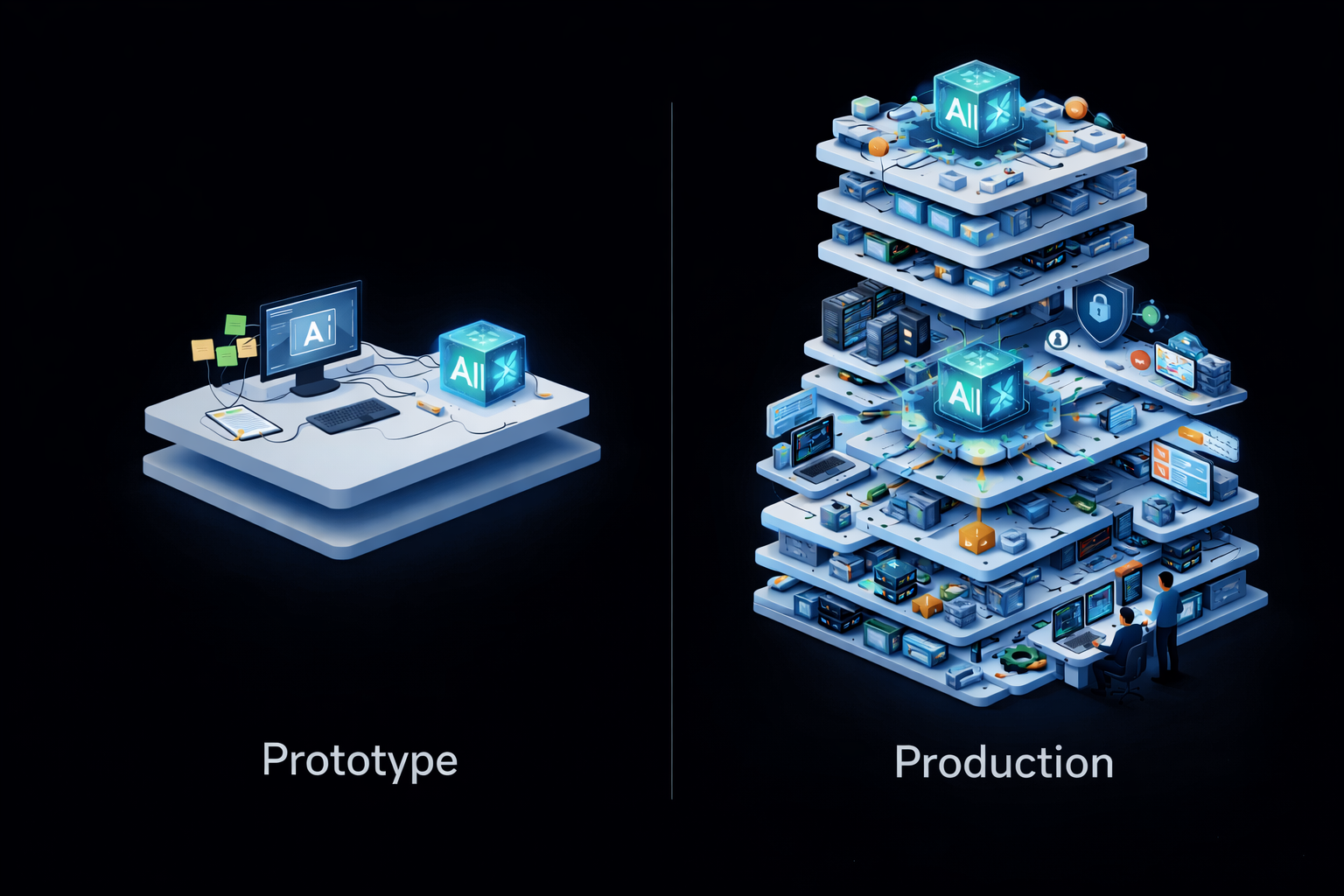
Prototypes are forgiving. Production environments are not.
In the real world, AI systems must operate continuously, react to live data and events, coordinate with other services and people, and recover seamlessly from failure. Latency matters. Serialization matters. Security boundaries matter. Decisions need to be traceable. Exceptions must be handled deterministically. None of these challenges are solved by simply choosing a better model or agent.
What organizations underestimate is that as soon as AI becomes operational embedded in workflows, responding to events, triggering actions – it stops being a model selection problem and becomes a systems design problem.
Without orchestration, teams stitch together pipelines, scripts, queues, APIs, and manual processes to hold everything together. The result may work – until it doesn’t. Small changes ripple unpredictably. Governance is documented but not enforced. Scaling introduces new failure modes. Each new AI capability adds friction instead of leverage.
An orchestration platform exists precisely to absorb and manage this complexity.
Orchestration Is Not Another Tool – It’s the Control Plane
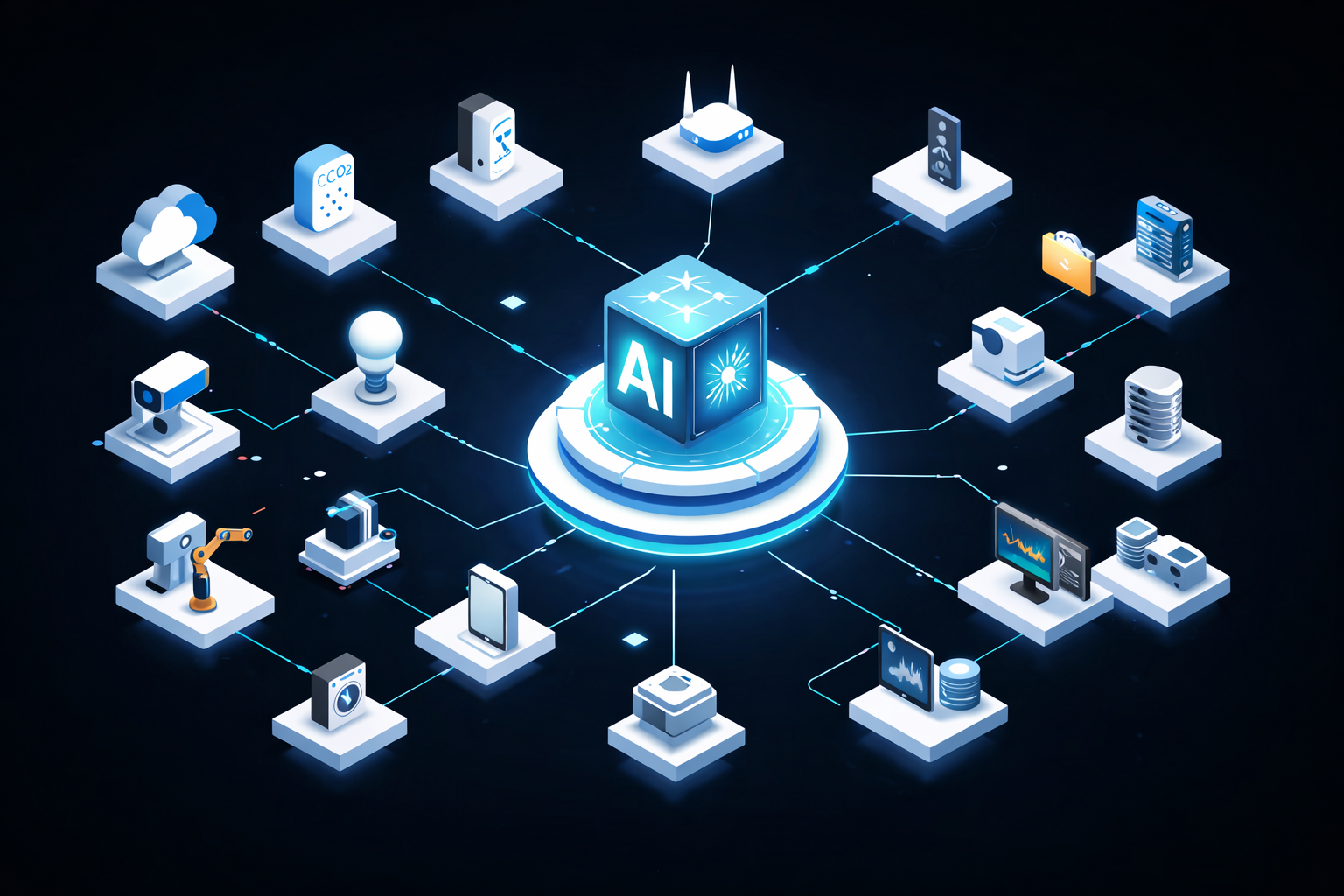
An AI orchestration platform is not a workflow engine, a model catalog, or an integration utility – though it may interact with all of them. Its role is more fundamental. It acts as the control plane where data, models, agents, business logic, and humans are coordinated at runtime.
This is exactly the role that an orchestration platform plays.
Tools solve isolated problems. Platforms define how systems behave over time.
With real-time orchestration in place, AI components no longer operate as independent experiments. They become managed participants in a larger system – one that can enforce policies, coordinate decisions, and adapt dynamically as conditions change. This is what allows AI to move from “interesting” to “operationally indispensable.”
Reliability, Governance, and Security Are Runtime Problems

Many AI strategies treat reliability, security, and governance as layers that can be added after a system is built. In practice, they are runtime concerns. They must be enforced at the moment decisions are made, actions are triggered, and data moves between systems.
Reliability, in particular, requires acknowledging a simple reality: AI does not always behave predictably. Models can hallucinate, return low-confidence results, or become temporarily unavailable due to connectivity issues or service disruptions. In production environments, these scenarios are not rare edge cases—they are inevitable. A dependable AI system must be able to detect these conditions and respond appropriately, falling back to deterministic logic, alternative models, human review, or predefined workflows. In other words, the system cannot assume the AI will always be correct; it must be designed to operate safely even when the AI is wrong, unavailable, or uncertain.
This becomes especially important in operational workflows—systems that escalate incidents, approve actions, or allocate resources in real time. Without a coordinating layer, there is no consistent mechanism to ensure approvals were requested, thresholds were respected, models were invoked appropriately, or decisions were logged for audit. Governance quickly becomes something documented in policy or tracked in a spreadsheet rather than enforced in the system itself.
An orchestration platform embeds these controls directly into execution paths. It ensures that AI-driven actions are observable, explainable, and interruptible—without slowing the system down—because governance, reliability, and security are designed into how the system operates from the start, rather than bolted on after deployment.
Platform Thinking Enables Adaptation, Not Lock – In

One of the quiet risks in today’s AI landscape is architectural rigidity. When AI solutions are built tightly around specific models or frameworks, change becomes expensive. Replacing a model can require reworking pipelines, logic, and integrations across the stack.
A platform-based orchestration approach decouples intelligence from implementation. Models become interchangeable. Agents can evolve. New capabilities can be introduced without destabilizing the system as a whole. This flexibility is what allows organizations to adopt new technologies as they emerge – without restarting their AI journey each time the landscape shifts.
Future readiness is not about predicting which model will win. It is about building an architecture that assumes change.
From Isolated Use Cases to Enterprise Systems
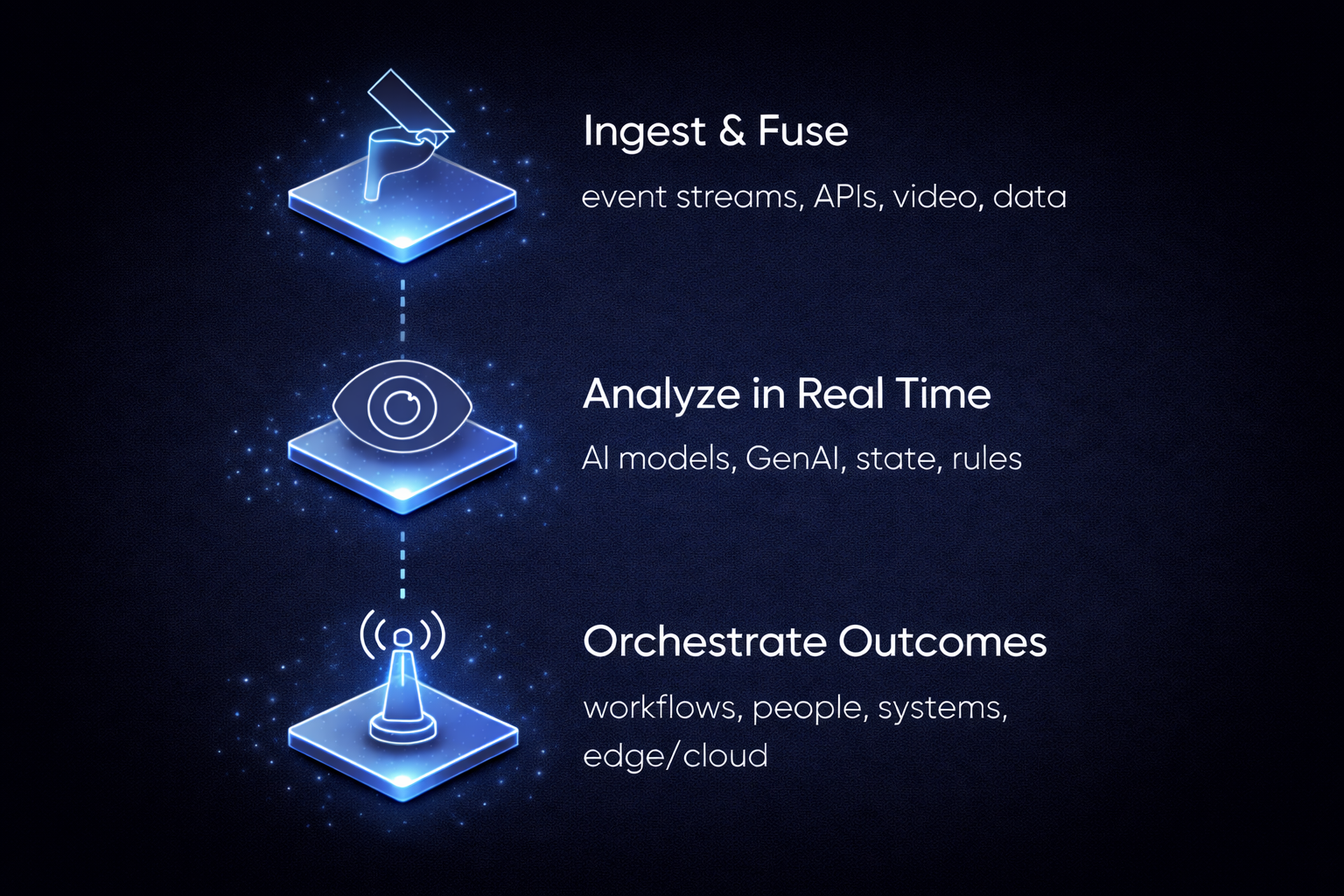
The real value of AI is not unlocked through individual use cases, but through systems that span departments, data sources, physical assets, and decision boundaries. That level of coordination does not emerge organically. It must be designed.
Real-time orchestration platforms make this possible by providing a unifying layer that aligns AI behavior with business operations. This shift is becoming a mandate for scale; recent research from Forrester reveals that 88% of IT leaders now believe AI adoption remains difficult to scale without a central orchestration framework. They turn fragmented initiatives into coherent systems – systems that can scale, comply, and evolve.Real-time orchestration platforms make this possible by providing a unifying layer that aligns AI behavior with business operations.
This shift is becoming a mandate for scale; recent research from Forrester reveals that 88% of IT leaders now believe AI adoption remains difficult to scale without a central orchestration framework. They turn fragmented initiatives into coherent systems – systems that can scale, comply, and evolve.
This is why organizations that treat orchestration as a foundational capability move faster over time, not slower. They stop rebuilding and start composing.
The Strategic Choice Ahead
The next phase of AI adoption will not be defined by who has access to the best models. It will be defined by who can run AI as a dependable, governed, continuously evolving part of their business.
If your AI strategy is centered on tools, pilots, and point solutions, it will always struggle to cross the gap into sustained operational impact. Orchestration is what closes that gap. It is the difference between AI as innovation theater and AI as infrastructure.
Platforms like Vantiq are not added at the end of an AI journey. They are the engine that makes the journey viable in the first place.
The question is no longer whether AI will be embedded into your core operations. The question is whether you are building the systems required to control it, trust it, and adapt it – at scale, over time, and under real-world conditions.
Sources
- Forrester Consulting, The State of AI Orchestration in IT, 2025.
https://www.tines.com/blog/introducing-forrester-study-2025-it-ai-orchestration/